Yin Yang Transparent Symbol: Free & Clean Downloads
The Yin-Yang symbol, a translucent mandala of duality, is an ancient graphic representation of the interdependence and interconnection of seemingly opposing forces. Its profound symbolism has permeated various aspects of culture, art, and philosophy, transcending boundaries to captivate people worldwide. At the heart of this fascination lies the symbol's transparency – the ability to perceive and grasp its inherent harmony through a delicate interplay of light and shade.
This iconic symbol, also known as the Tao, embodies the unified field theory of ancient Chinese philosophy. It portrays a balance of two energies – Yin and Yang – which are personified as female and male principles, respectively. The design's translucency allows these energies to interpenetrate, fostering a rich dialogue about the nature of existence, change, and stasis.
The Symbolism of Yin and Yang
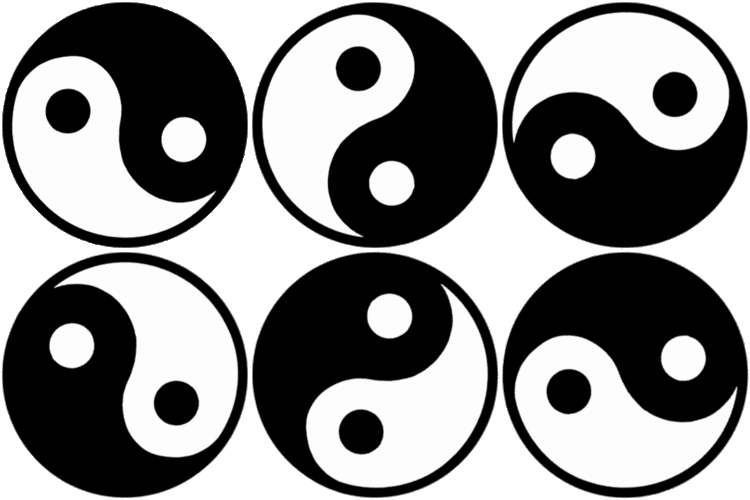
The Yin symbol is represented by a dark, usually black, segment,_embodied by a sinuous line that carves a crescent moon from the circle. This half of the symbol signifies dark, passive, feminine, and earth-associated qualities – the valleys, the night, the moon, and the earth itself. It epitomizes potential, stillness, and the mysterious aspects of life.


The Yang, conversely, is symbolized by a white, often dotted, crescent that forms the other segment of the circle. This side signifies light, active, masculine, and sunny-associated elements – the peaks, the day, the sun, and the sky. Yang embodies progress, movement, and the tangible aspects of reality.
The Interconnectedness of Opposites
The Yin-Yang symbol reflects the Buddhist and Taoist philosophy that all phenomena are interdependent and interconnected. Even in the eye of a storm, there is a still center. The white dot within the Yin represents the seed of Yang within Yin, while the black dot within the Yang represents the seed of Yin within Yang. This embeds the concept of potential and growth, signifying that everyYang has a Yin aspect, and every Yin, a Yang aspect.


This concept finds resonance in modern physics.波 Quantum mechanics, for example, illustrates the dual nature of light and matter. They behave as waves and particles simultaneously, encapsulating the Yin-Yang principle of duality and interdependence. This interconnectedness extends to all facets of life, including art, psychology, and ecology.
The Symbol's Interpretation Across Cultures
The Yin-Yang symbol has transcended beyond its Chinese origins to become a universal metaphor of balance and harmony. In Japanese culture, it signifies the inseparable relationship between humans and nature, as well as the unity of mind and body. In Korea, the symbol reflects the balance between heaven and earth, humans and nature, and life and death.
In theWestern world, psychologists have adopted the Yin-Yang symbol to illustrate the balance needed between opposing aspects of the self to achieve stability – such as introversion vs. extroversion, left-brain vs. right-brain dominance, and conscious vs. unconscious conflicts. The translucency in the symbol beautifully resonates with this Western interpretation, reflecting the transparency and open communication necessary between these opposing traits.



The Yin-Yang as a Design Element
The Yin-Yang symbol's aesthetic simplicity, along with its profound symbolism, has made it a popular design element. From Chinese calligraphy to Japanese woodblock prints, the symbol stands out as an iconic visual motif. Its monochromatic simplicity facilitates versatile representation on various mediums, from clothing and jewelry to architectural designs and digital software interfaces.
The translucency of the symbol allows designers to employ it as a visual metaphor for the interconnectedness of life. They can integrate it translucently into other designs or use the light and shade interplay to create intriguing visual effects, reflecting the eastern philosophical approach to design.
Yin-Yang in Pop Culture and Advertising
The Yin-Yang symbol transcends the realms of art and philosophy to become a ubiquitous presence in popular culture and advertising. TheInternational Olympic Committee adopted a modified Yin-Yang symbol for the emblem of the 2022 Winter Olympics, reflecting the balance and harmony theme. The symbol also features extensively in movies, music, and literature.


In advertisements, the Yin-Yang symbol often represents totality, unity, and balance. Nike uses a partial Yin-Yang symbol in its 'Just Do It' campaigns, symbolizing individual empowerment and progress. Similarly, Apple embeds the Yin-Yang symbol in its iOS designs, signifying the balance between form and function in its products.
As we navigate the complexities and dualities of life, the Yin-Yang symbol remains a timeless reminder of harmony and balance. Its translucent design, like a crystal ball, allows us to glimpse into the interconnectedness of all things, empowering us to embrace and appreciate the dual nature of existence. In a world of polarizing opposites, the Yin-Yang invites us to see through the shades, to illuminate and understand the wholeness within ourselves and our surroundings.
Related Articles

Yin Yang Symbol Transparent PNG & PNG
The Yin Yang symbol, with its interlocked circles of black and white, is a profound and harmonious representation of balance and unity. This ancient Chinese...

Transparent Math PNG Clipart: Free Downloads for Designs
In the digital age, images play a pivotal role in data visualization and communication, especially in educational and professional settings. When it comes to...

Transparent Pillow Clipart: Free Downloads
In the vast realm of digital art and design, clip art has long been a versatile tool for embellishing projects. One of the most sought-after types of clip art...

Brite Bomber Transparent Background: Free PNG Downloads
Imagine an artist's palette, but instead of paint, we're talking about digital colors. Welcome to the world of Brite Bomber, the dynamic Aero Assault outfit...

Black Outline PNG: Free Downloads & Transparent Vector
Black outline PNG graphics, suministrated with a transparent background, are particularly useful in web design and visual content creation. The term "black...

Transparent Question Mark PNG: Free High-Quality Downloads
In the realm of digital graphics, transparency has become a staple for creating elegant and professional designs. Transparent PNG images, with their alpha...