Lowercase Letter 'h': Spelling & Usage Tips
The lowercase letter 'h', often overlooked due to its unassuming nature, plays a significant role in the English language. It's the eighth letter in the alphabet and a humble consonant sound, but it's the backbone of countless words, phrases, and ideas.
The letter 'h' has an interesting history, with its origins dating back to ancient Egyptian hieroglyphics. Over time, it has evolved in different languages and cultures, yet its core form and function remain integral to modern communication.
The Phonetic Value of 'h'
The letter 'h' has a unique phonetic value, representing a specific sound. In English, it generally represents the voiceless glottal fricative, a sound that's produced by a narrow opening in the glottis. This is the same sound that occurs at the beginning of words like 'hot' or 'house'.


However, the letter 'h' also functions as a silent letter in many words in English. For instance, in words like 'hour', 'honor', or 'herb', the 'h' is silent. This has led to interesting etymological and phonetic debates among linguists.
The Silent 'h'
The silent 'h' is a quirk of the English language, with roots tracing back to Old French and Old Norse languages. Over time, as words evolved and languages merged, the 'h' sound disappeared in many words, but the letter remained.
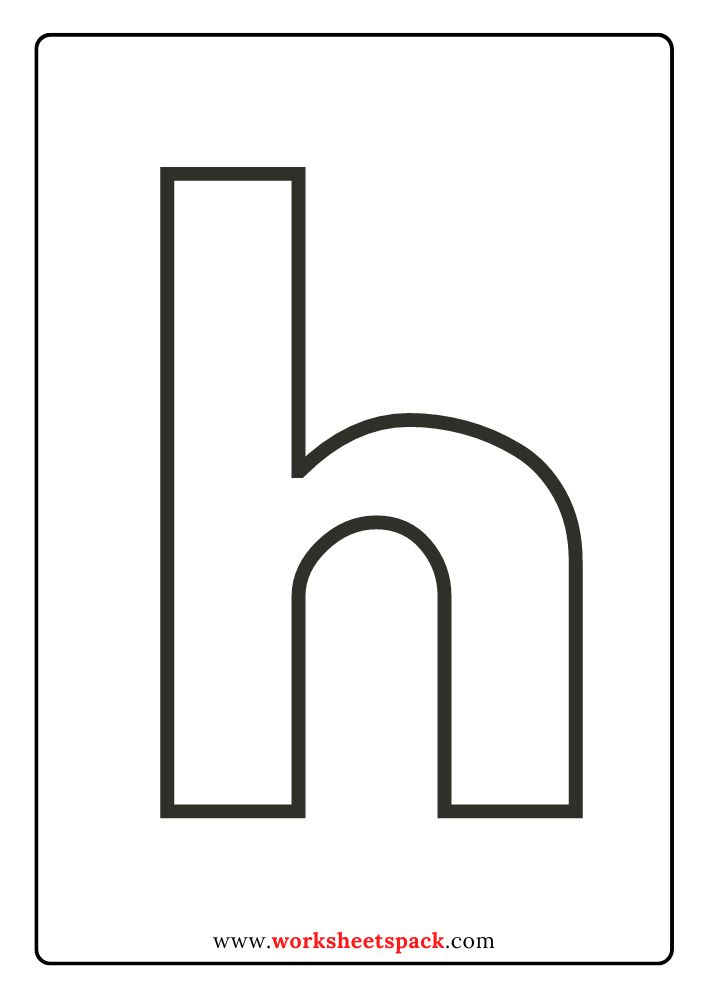


This can make learning to read English challenging, as children must learn to recognize that not all letters in a word represent a sound. However, it also contributes to the rich tapestry of English and its unique vocabulary.
'H' in Other Languages
In many other languages, the letter 'h' functions as a straightforward consonant, consistently representing a specific sound. For example, in Spanish, 'h' is pronounced consistently as the aspired glottal fricative. This is because Spanish has been influenced less by languages that use silent 'h'.
However, languages like French, which have had significant contact with English, also feature silent 'h's in certain words, mirroring the English pattern.


The Letter 'H' in Writing
The letter 'h', besides its semantic value, also plays a crucial role in writing and typesetting. It's often used for horizontal line elements in typography, due to its broad proportions. This lends it to use in a variety of design and layout contexts.
The lowercase 'h' is also the smallest letter in many typefaces, which can present challenges in legibility and design. This has led to various innovations in type design, aiming to make the 'h' more distinct and legible.
Design and Legibility
Designers have addressed the legibility issue of the lowercase 'h' by adjusting its proportions, adding distinctive features, or using contextual alternates. For instance, some fonts have a 'Harry' or 'h-legibility' variant, where the 'h' has extra shaping to make it more distinguishable from similar letters like 'n' or 'm'.


Moreover, the 'h' is often used in logotypes, owing to its simple, elegant shape. It can convey a sense of minimalism, modernity, or understated class, depending on the context and accompanying typography.
'H' in Unicode and Computing
In computer science, the lowercase 'h' is represented by the Unicode character U+0068. It's part of the Basic Latin block, which includes all ASCII characters. This ensures that the 'h' can be rendered consistently across different platforms and programming languages.
The 'h' also has special functions in programming, such as in regular expressions, where it can represent any character (when used with a modifier). It also plays a role in formatting strings in many languages.
In conclusion, the lowercase letter 'h' may seem simple, but it's a critical component of language, writing, and computing. Its unique phonetic value, its role in design and typing, and its importance in computer science make it a fascinating subject to explore. Whether you're a linguist, a designer, or a programmer, the humble 'h' deserves your respect and admiration for its versatility and utility. So, the next time you write or see an 'h', appreciate the power and history behind this small yet mighty letter."
Related Articles

Envelope Symbol for Letters: Meaning & Usage
The elegant curve of the envelope symbol, □, captures the essence of correspondence, evoking images of letters and missives from yesteryears. This simple yet...

Angel Wings Emoji Revealed: Unlock Hidden Meaning & Usage Tips
The angel wings emoji 👼, a cherubic little symbol, has become a staple in the digital communication landscape. It was first introduced in Unicode 6.0 in 2010...

Bulma Image PNG: Free Download & Usage Tips
Bulma is an increasingly popular CSS library that simplifies the process of creating responsive, mobile-first websites. One of its standout features is the...

Super Mario Bros Transparent Logo: Free Download & Usage Tips
The Super Smash Bros. transparent logo is a beloved icon in the gaming community, swiftly recognizable by its bold, stylized font and Nintendo-themed insignia...

Learn the Art of Bubble Lettering: A Guide to Lowercase Styles
The allure of typography is undeniable, with its numerous styles, fonts, and variations adding a unique flair to any design. Among these, bubble letters...

Craft a Spelling Cable Masterpiece: Letter S Made with Cable
When it comes to unique and innovative decor ideas, the humble cable transforms into a sculptor's tool, creating astonorishing patterns and structures with...